💡 Why Does Everyone Praise Hard Work, but Ignore Smart Work?
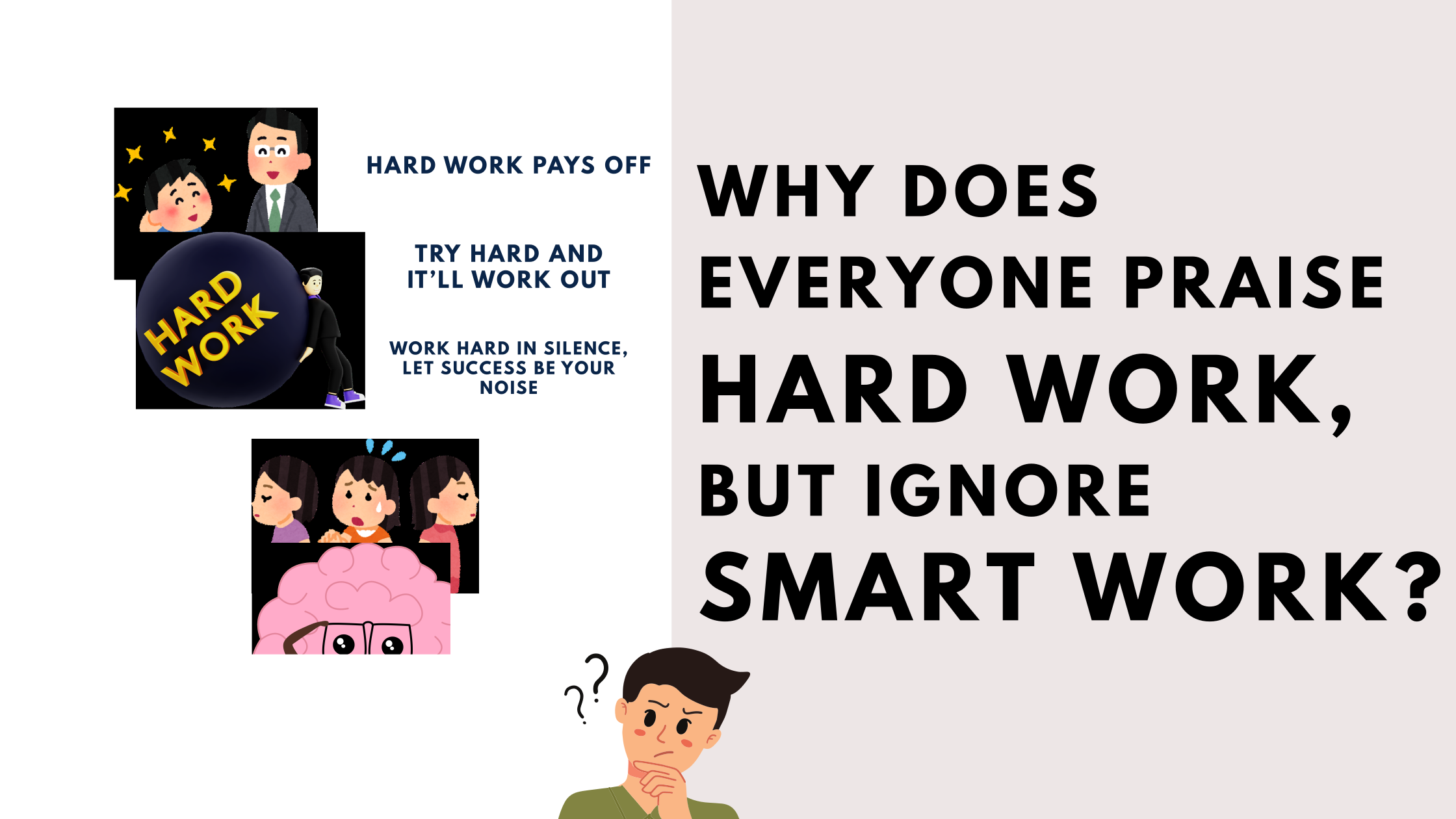
A deep dive into why working smart is often overlooked, and why it shouldn't be.
The world has long been obsessed with the idea of hard work. From school essays to job interviews, we are taught to value persistence, discipline, and long hours of labor. Phrases like "hard work pays off" or "there's no substitute for hard work" are ingrained in our culture, and it's no surprise that we often list ourselves as hardworking on resumes and mention it in interviews.
However, as the world evolves rapidly with technology, efficiency, and innovation at the forefront, shouldn't there be a shift toward smart work? In an era of complex challenges and ever-changing landscapes, is working harder always the best solution, or should we focus on working smarter?
Let's explore why smart work is becoming the preferred approach in today's fast-paced, results-oriented world.
The Traditional Value of Hard Work
For centuries, hard work has been celebrated as the cornerstone of success. It's often tied to traits like perseverance, discipline, and grit. In cultures around the world, working long hours, striving for perfection, and being willing to sacrifice time and energy have been praised as the ultimate path to success.
Example:
Think about the long-standing advice passed down from generation to generation: "If you want to be successful, you need to put in 100% effort." We've all been taught that working tirelessly toward a goal will eventually bring rewards. However, this narrative doesn't always hold true, especially in today's competitive, ever-changing landscape.
The Rise of Smart Work
In the modern world, smart work isn't about exerting more effort but about maximizing efficiency and leveraging available tools, strategies, and knowledge. It's about working intelligently, prioritizing tasks, and optimizing your time to yield better results with less effort.
What is Smart Work?
Smart work involves strategic thinking, problem-solving, and working efficiently. It's about choosing the right tasks, using the right tools, and maintaining work-life balance while achieving high productivity. Instead of focusing solely on the amount of time spent on a task, smart work focuses on how to complete tasks in the most effective manner possible (Hallowell, 2005).
Example:
A software developer who automates repetitive tasks or uses programming frameworks to speed up the coding process is working smarter, not harder. The focus is on increasing productivity without burning out or wasting time (Drucker, 2009).
Example: Hard Work vs. Smart Work in Project Development
As part of an academic assignment, I interviewed an IT industry leader in Nepal who shared an interesting insight. He mentioned that people often spend an entire year building a product from scratch, and if it fails, they become demotivated. He also pointed out that by using open-source resources and integrating personal logic, you could build something valuable in 3 to 6 months.
In this case, instead of spending a year on a single project with no guarantee of success, you could spend that same year working on multiple projects. Even if none of them guarantee success, you'd have more opportunities to learn, innovate, and pivot. Smart work doesn't just mean working harder, it's about maximizing productivity, reducing risk, and creating more chances for success. This approach gives you multiple shots at success instead of just one.
The Smart Work vs. Hard Work Debate: Why Hard Work Isn't Always the Answer
The Myth of Overworking
The culture of overwork often glorifies the idea that working longer hours equates to success. However, this mentality can lead to a toxic work culture that values quantity over quality. People who are constantly working hard may be seen as diligent or dedicated, but in reality, they may be wasting time on tasks that don't contribute much to their overall goals. In the long run, this overemphasis on hard work can lead to exhaustion and diminished efficiency (Schwartz, 2004).
Example:
Consider the corporate world, where people may pride themselves on working 12-hour days. They might feel accomplished, but they often don't realize that they could have accomplished the same tasks in half the time with better organization and strategic thinking (Baker, 2018).
Smart Work in Action: Efficiency Over Hours
Smart work is about prioritizing efficiency and outcome-oriented strategies. Let's look at some examples.
Entrepreneurs and Business Owners
Successful entrepreneurs don't just grind away day and night. They delegate tasks, build systems, and automate processes to create scalable businesses. For instance, a startup founder may hire a team to manage day-to-day operations, allowing them to focus on scaling the business, fostering innovation, and forming strategic partnerships. This approach allows them to grow their company faster than if they were doing everything on their own (Miller, 2017).
Freelancers and Remote Workers
Freelancers often work on tight deadlines, yet they understand the importance of working smarter. By using productivity tools like time tracking apps, project management software, and automating repetitive tasks, they can handle more clients and deliver better results in less time (O'Neill, 2020).
The Corporate Worker Who Leverages Technology
In corporate settings, smart workers use technology to streamline their tasks. For example, using a project management tool like Trello or Asana allows them to organize and prioritize work more effectively, ensuring they aren't overwhelmed by tasks and can allocate their time based on what truly matters (Hallowell, 2005).
Example: Smart Work in Action
In class, my teacher gave us a series of math problems to solve using ASCII values: addition, subtraction, multiplication, and division. While others did each operation step by step, I quickly solved them in a minute. The teacher questioned, "Isn't this cheating? You're supposed to work through every step."
I responded, "Isn't the point to understand the logic? In coding, we focus on reusability, creating solutions that save time. Why repeat every step when you can apply the logic efficiently and reuse it?"
This shows how smart work is about leveraging existing knowledge to work more efficiently, rather than just putting in more hours of hard work. By reusing logic and applying it in different contexts, we can solve problems faster and more effectively. Smart work focuses on finding solutions that are not only faster but also scalable and repeatable (Drucker, 2009).
Conclusion: The Future of Work Is Smart
As the work landscape continues to evolve, the value of smart work will only increase. In a world where technology, automation, and artificial intelligence are reshaping industries, those who can adapt, think strategically, and leverage their resources efficiently will be better positioned for success.
Hard work is no longer the only route to success. It's about working smarter, making informed decisions, and focusing on what truly drives results. By combining the wisdom of hard work with the efficiency of smart work, individuals can not only achieve their professional goals but also maintain a healthy work-life balance and lead a more fulfilling career.
References
Baker, T. (2018). The paradox of productivity: Why working harder isn't always better. Harvard Business Review. Retrieved from https://hbr.org
Drucker, P. F. (2009). The essential Drucker: The best of sixty years of Peter Drucker's essential writings on management. HarperBusiness.
Hallowell, E. M. (2005). Overloaded circuits: Why smart people underperform. Harvard Business Review, 83(1), 54–62. https://doi.org/10.1177/0008125607081001001
Miller, P. (2017). Smart work: How to make your work work for you. Penguin Group.
O'Neill, P. (2020). Freelancing: A smart worker's guide to optimizing your time and achieving more. Career Development Quarterly, 68(4), 312–320. https://doi.org/10.1002/cdq.12228
Schwartz, B. (2004). The paradox of choice: Why more is less. HarperCollins.
✍️ Written in VS Code. Compiled with caffeine. Deployed from the heart.